
AI Agents vs BPA vs Agentic Workflows: Understanding the Differences
Artificial intelligence is revolutionizing organizational operations, but the terminology can be confusing. Three key concepts are often discussed: AI Agents, Business Process Automation (BPA), and Agentic Workflows. This article explores the distinctions between these, clarifying their roles and value in modern enterprises.

1. AI Agents: Intelligent and Autonomous
AI agents are software entities endowed with artificial intelligence capabilities. They perceive their environment, make decisions, and act autonomously. Unlike traditional bots, AI agents can:
Operate with limited human intervention
Learn from data and past experiences
Tackle complex scenarios by adapting their strategies
Typically, AI agents handle tasks such as customer support, data analysis, or personalized recommendations. They excel where context, nuance, and adaptability are required.
2. Business Process Automation (BPA): Efficiency Through Automation
BPA refers to technology-driven automation of routine, repeatable business processes. It commonly relies on rule-based systems, workflows, and integrations across applications. The key differences include:
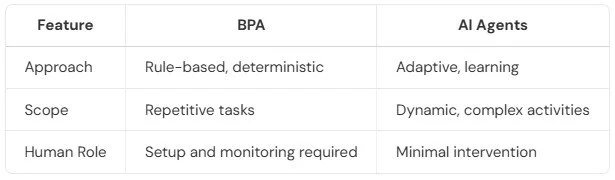
3. Agentic Workflows: Orchestrating Intelligent Processes
Agentic workflows represent the next evolution—combining AI agents within end-to-end business processes. Here, multiple agents collaborate, negotiate, and make decisions. These workflows are:
Modular and flexible (agents can be added/replaced)
Adaptive to changing business needs
Able to autonomously resolve exceptions, optimize outcomes
This approach unlocks scalable automation beyond what BPA can offer, enabling organizations to manage complex operations with minimal oversight.
4. Comparing the Three: Key Differentiators
AspectAI AgentsBusiness Process Automation (BPA)Agentic WorkflowsIntelligenceHighLow (rule-based)Distributed, collaborativeAdaptabilityStrongLimitedVery strongUse CasesCustomer service, analyticsInvoice processing, onboardingMulti-agent coordination, dynamic processesAutonomyPartial to fullLimitedFull
Conclusion
While BPA remains valuable for streamlining repetitive tasks, AI agents introduce intelligence and autonomy for more complex operations. Agentic workflows, meanwhile, harness collections of AI agents working together, enabling organizations to orchestrate intelligent processes at scale. Understanding these distinctions is crucial for leaders seeking to drive meaningful digital transformation.
